Recycling equipment manufacturerFor a green future


The core of the mechanical processing of lithium-ion batteries lies in utilizing a combination of equipment—including crushing, screening, and physical sorting devices—to achieve the efficient separation and recovery of metals and active materials contained within the batteries, thereby enhancing resource utilization and mitigating processing risks.
I. Pre-treatment and Crushing System: The Starting Point for Safety and Efficiency
Within the entire production line, the pre-treatment equipment dictates the effectiveness of subsequent sorting operations. Typically, a discharge device or low-temperature treatment is employed first to reduce the battery's electrochemical activity, thereby preventing the risk of combustion or explosion during the crushing process. The material then proceeds to a dual-shaft shredder or coarse crusher, where entire battery packs or modules are broken down into larger fragments.
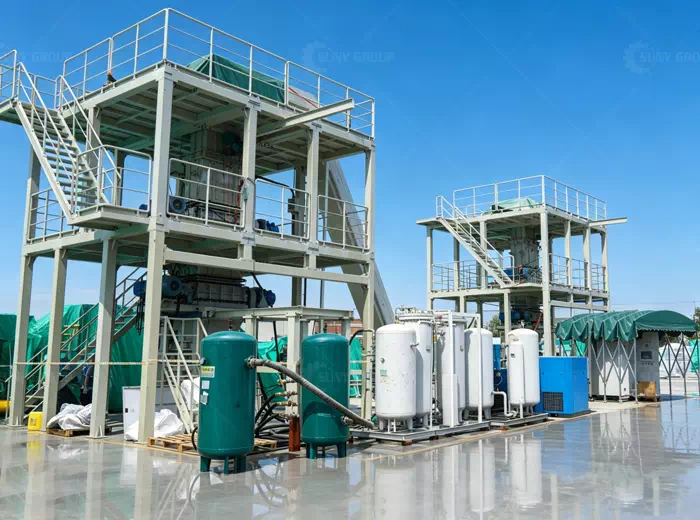
Mechanical Processing of Lithium-ion Batteries
Subsequently, a fine crusher or hammer mill is utilized to control the particle size within a reasonable range (typically 10–20 mm), creating the optimal conditions for the downstream sorting stages. The equipment at this stage places a strong emphasis on airtightness and explosion-proof design, while also being integrated with a dust removal system to minimize the leakage of dust and hazardous gases.
II. Sorting and Material Recovery System: The Core Value-Creation Stage
The crushed mixture contains a blend of copper, aluminum, plastic separators, and "black powder" (the active materials from the cathodes and anodes). At this juncture, a multi-stage sorting system involving various pieces of equipment working in tandem is required:
First, a vibrating screen is used to classify the particles by size; next, an airflow separator is employed to separate the lightweight separators from the heavier metals; finally, a magnetic separator is utilized to remove any ferrous impurities.
The critical stages involve specific gravity separation and electrostatic separation systems. Specific gravity separation allows for the preliminary separation of copper and aluminum particles, while electrostatic separation leverages the differences in electrical conductivity between various materials to achieve a further, highly refined separation of copper, aluminum, and the black powder. This combined approach directly determines the purity of the recovered materials and their resulting economic value.
III. Dust Management and System Integration: Ensuring Stable Operations
The mechanical processing of lithium-ion batteries generates substantial quantities of fine dust and volatile substances; consequently, the environmental control system is an indispensable component of the process. The entire production line is typically equipped with pulse dust collectors, negative-pressure conveying systems, and exhaust gas treatment units to ensure that the production environment remains safe and compliant with regulatory standards.
Concurrently, an automated control system integrates and synchronizes the various pieces of equipment, enabling continuous feeding, stable operation, and proactive fault detection. This automation minimizes the need for manual intervention and significantly enhances overall processing efficiency.
Thank you for your interest in suny group. If you want to learn more about our E-waste recycling plant, copper wire recycling machine and other machines, Contact us now to find out what we can do for you next project!E-mail:[email protected] | Whatsapp:+8613674945231