Recycling equipment manufacturerFor a green future
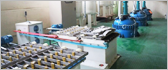
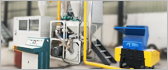
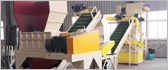
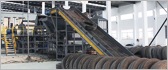


The waste lithium battery recycling production line uses crushing, screening, and sorting equipment to convert batteries into black powder, copper, aluminum, and other recyclable materials. Combined with a hydrometallurgical process for black powder, valuable metals such as lithium, nickel, cobalt, and manganese are extracted. This line is suitable for the resource recovery of power batteries, energy storage batteries, and other waste lithium batteries.
Lithium Battery Front-End Crushing and Black Powder Sorting Equipment
The front end of the lithium battery recycling production line is primarily responsible for converting waste batteries into black powder (black mass) that can be further processed, while separating components such as copper, aluminum, iron, and plastics. For different raw materials such as power battery packs, cylindrical batteries, and pouch batteries, the equipment configuration needs to be adjusted according to their size, structure, and battery chemistry.
A typical equipment combination includes a discharge unit, unpacking equipment, a twin-shaft shredder, a hammer crusher, a fine crusher, a vibrating screen, a magnetic separator, an air separator, a conveyor, and a dust removal system.
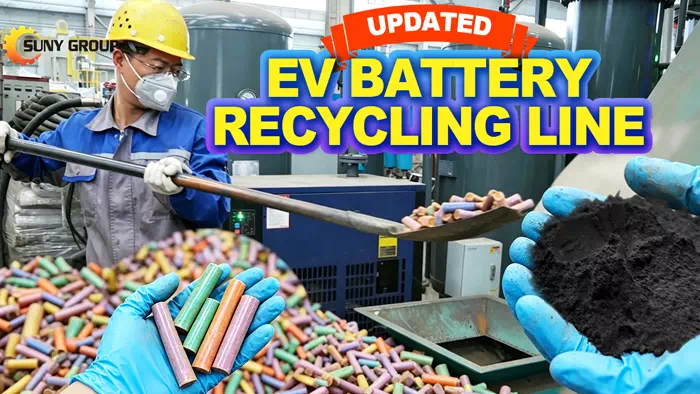
Lithium Battery Recycling Machinery for Black Mass Processing
The focus of the crushing stage is not simply reducing the size of the material, but rather ensuring the complete separation of the positive and negative electrode active materials from the copper foil, aluminum foil, and outer casing. A dual-shaft shredder handles the initial crushing, followed by a hammer crusher and fine crushing equipment to further release electrode powder. Vibrating screens classify by particle size, magnetic separators remove ferromagnetic impurities, and air classifiers utilize density and aerodynamic differences to separate light diaphragms from heavier metals. Some production lines also include eddy current separators to improve non-ferrous metal separation.
The yield and purity of black powder are affected by factors such as battery type, crushing particle size, screening efficiency, and residual binders; the recycling effect cannot be judged solely by the number of equipment.
Production Line Configuration and Safety Control
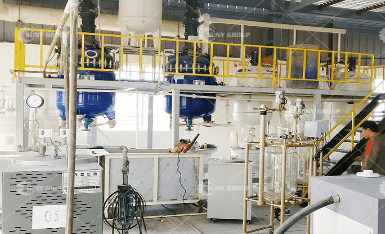
A complete Lithium Battery Recycling Machinery typically consists of mechanical pretreatment, black powder collection, hydrometallurgy, and environmental protection systems. The front-end equipment determines material dissociation and black powder quality, while the back-end reaction and separation equipment determines the metal recovery path and product quality.
In equipment configuration, dust removal, exhaust gas treatment, temperature monitoring, and automatic control should not be considered as additional items. The lithium battery crushing process may result in residual charge, combustible dust, and electrolyte volatiles. Therefore, it is necessary to configure discharge, closed-loop conveying, dust removal, and waste gas treatment devices according to the raw material's condition, and to evaluate inert gas protection and fire-fighting measures in conjunction with the specific process.
For companies planning to build lithium battery recycling plants, it is recommended to first determine the battery type, processing capacity, and target products, and then conduct small-scale or pilot-scale tests to verify the black powder particle size, metal content, and leaching separation effect. This ensures the rational selection of crushing and sorting equipment and hydrometallurgical systems, avoiding mismatches between equipment configuration and actual raw materials.
Thank you for your interest in suny group. If you want to learn more about our E-waste recycling plant, copper wire recycling machine and other machines, Contact us now to find out what we can do for you next project!E-mail:[email protected] | Whatsapp:+8613674945231