Recycling equipment manufacturerFor a green future


As the product lifecycle for electronics shortens and the volume of retired new energy vehicles, power electronics, and communication equipment surges, the global quantity of waste printed circuit boards (PCBs) continues to rise. Industry data indicates that waste PCBs typically contain 15%–30% copper; furthermore, the value of precious metals in certain high-end communication and server boards often exceeds that of natural ores, making them highly valuable for resource recovery.
However, PCBs are complex multi-layer composites containing copper foil, fiberglass, epoxy resin, and trace amounts of precious metals. Improper control of particle size during crushing can lead to issues such as copper powder encapsulation, metal loss, and reduced separation efficiency. Recent industry trends have shifted from simple crushing to precision liberation, making the performance of crushing and grinding equipment a critical factor in determining recovery profitability.
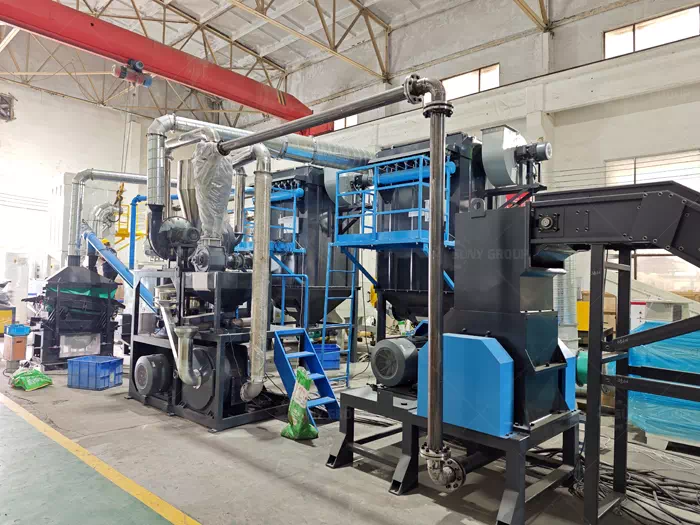
PCB Crushing and Grinding Equipment
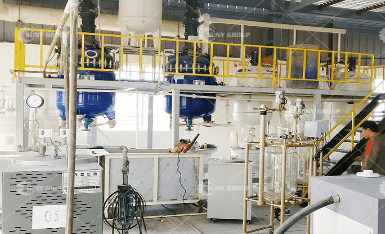
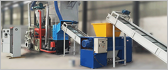
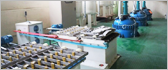
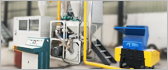
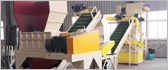
To address waste computer motherboards, communication boards, circuit board offcuts, and electronic component scrap, SUNY GROUP has developed a comprehensive mechanical PCB recycling solution. Core equipment includes dual-shaft shredders, coarse crushers, hammer mills, turbo pulverizers, and multi-stage screening systems.
The production line begins by processing whole circuit boards into 30–50 mm particles using a low-speed dual-shaft shredder, thereby reducing the load on downstream equipment. The material then enters a high-speed crushing stage, where it is further reduced to under 5 mm, achieving initial separation of copper foil from resin materials.
To enhance the metal liberation rate, the system incorporates a fine grinding unit that reduces a portion of the material to the 20–40 mesh range, ensuring the full release of copper, fiberglass, and resin powders. Subsequently, a combination of air, gravity, and electrostatic separation technologies is employed to effectively separate copper powder from non-metallic materials.
The entire system utilizes negative-pressure conveying and pulse dust collection designs to effectively control dust dispersion while minimizing the loss of fine particles. Depending on raw material composition and processing capacity requirements, the production line can be configured with capacities ranging from 100 kg/h to 2,000 kg/h, catering to the needs of both small-to-medium-sized recycling enterprises and large-scale industrial projects. As the global volume of electronic waste continues to rise, PCB crushing and grinding equipment is shifting from auxiliary machinery to core infrastructure within the electronic waste resource recovery system; the technological sophistication of this equipment will largely determine the economic viability and market competitiveness of recycling projects in the future.
Thank you for your interest in suny group. If you want to learn more about our E-waste recycling plant, copper wire recycling machine and other machines, Contact us now to find out what we can do for you next project!E-mail:[email protected] | Whatsapp:+8613674945231