Recycling equipment manufacturerFor a green future


With the continuous growth of global photovoltaic (PV) installed capacity, a large number of early-installed solar modules are gradually entering their retirement cycle. Automated PV module recycling production lines, through processes such as crushing, separation, and sorting, effectively recycle glass, aluminum, silicon, and metal resources, representing a crucial equipment solution for improving resource utilization and reducing processing costs.
Composition and Working Principle of Automated PV Module Recycling Production Lines
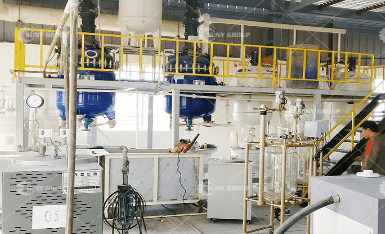
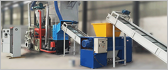
A complete solar panel recycling system typically consists of a conveying system, frame dismantling equipment, crusher, pulverizer, screening system, air classifier system, and dust removal device.
Waste PV modules first enter the frame dismantling process, automatically separating the aluminum alloy frame and junction box. The modules then enter the crushing system, where the laminated structure is crushed to a suitable particle size for sorting. After multi-stage crushing, the material enters the screening and air classification stages, where materials of different densities and particle sizes are gradually separated.
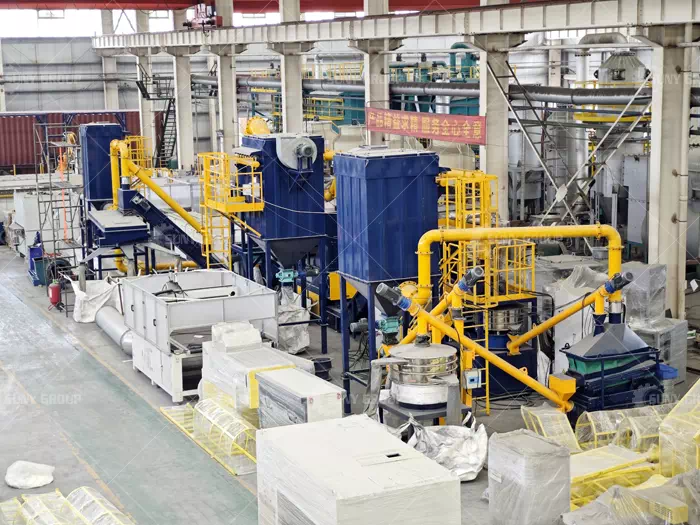
Photovoltaic Panel Recycling and Processing Machine
This process effectively recycles:
Glass materials (approximately 65%-75% of the total module weight)
Aluminum alloy frames (approximately 10%-15%)
Silicon materials and metal powder
Conductive materials such as copper
The entire processing system employs a closed-loop design and is equipped with a dust removal system to reduce dust spillage and improve the production environment.
Equipment Advantages and Practical Application Value
Compared to traditional manual dismantling, automated photovoltaic panel recycling equipment features continuous operation, stable processing capacity, and low labor costs.
Taking common crystalline silicon solar panels as an example, approximately 700 kg of glass, over 100 kg of aluminum, and a certain proportion of copper and silicon materials can typically be recycled from each ton of waste modules. With the rapid increase in the number of waste photovoltaic modules, the value of resource recycling is continuously increasing.
The biggest advantage of automated equipment is not simply increased processing speed, but rather ensuring the purity of the recycled materials. High-purity glass and metal materials are more easily incorporated into the reuse process, thereby improving overall economic efficiency.
For professional recycling companies, stable sorting results are often more important than simply pursuing high output, as the final profit depends primarily on the quality and sales value of the recycled materials.
Suitable for large-scale photovoltaic module recycling projects
Automated solar panel recycling production lines are suitable for processing scrapped modules, defective modules, modules damaged during transportation, and modules retired from photovoltaic power plants. The equipment can be customized to meet customer capacity requirements, ranging from small-scale pilot lines to industrial-scale continuous production lines.
With the continued increase in the volume of retired photovoltaic modules in the future, automated, large-scale, and resource-based recycling will become important directions for industry development. Through scientific crushing and sorting processes, not only can resource recovery rates be improved, but it also helps to promote a more complete circular economy system in the photovoltaic industry.
Thank you for your interest in suny group. If you want to learn more about our E-waste recycling plant, copper wire recycling machine and other machines, Contact us now to find out what we can do for you next project!E-mail:[email protected] | Whatsapp:+8613674945231