Recycling equipment manufacturerFor a green future
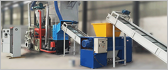
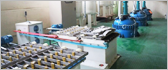
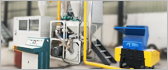
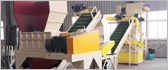
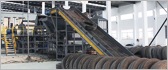


A waste tire recycling line is an industrial equipment system that transforms whole tires into rubber granules, steel wire, and fibers through a process of shredding, separation, and screening. It not only addresses the environmental pollution caused by accumulated waste tires but also converts discarded materials into reusable raw resources, finding widespread application in the recycled rubber, running track material, and general rubber product manufacturing industries.
A complete tire recycling line typically consists of multiple stages of equipment working in tandem. The initial stage involves a tire cutter or bead cutter, used to remove the steel bead rings and pre-process large tires into a structure that is easier to shred. The material then proceeds to a dual-shaft shredder, which tears the tires into smaller chunks—a critical step for reducing energy consumption in subsequent processing stages.
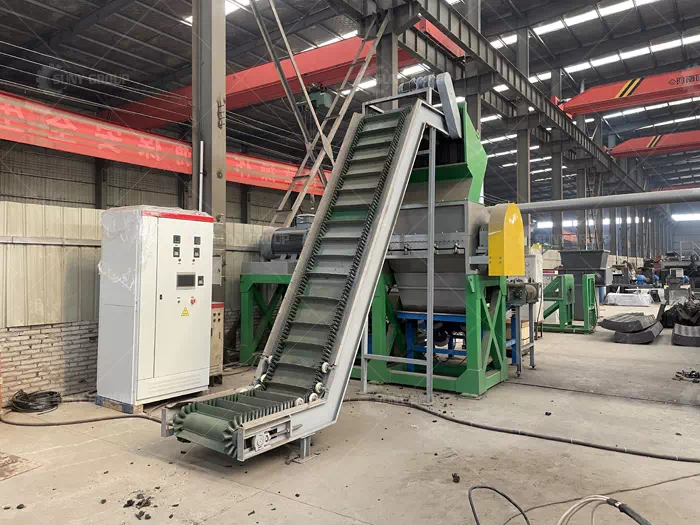
Used Tire Recycling Production Line
Next is the fine-shredding system—typically utilizing a rubber granulator or crusher—which further processes the material down to the required particle size. Concurrently, magnetic separation equipment is employed to efficiently extract steel wire from the rubber, while an air classification system removes fibrous impurities, thereby ensuring the purity of the final rubber granules. Finally, screening equipment is used to control the particle size of the finished product, enabling the classification and output of materials in various specifications.
The core strengths of tire recycling equipment lie in its operational stability and separation precision. High-quality shredders require high torque and wear-resistant blades to ensure continuous operation, even when processing steel-belted tires. The efficiency of the magnetic separation system directly impacts the steel recovery rate, while the precision of the air classification system determines the level of residual fibers remaining in the rubber granules.
In terms of capacity, standard production lines typically process anywhere from 500 kilograms to several tons of material per hour, depending on the specific equipment configuration and level of automation. Throughout the entire operation, dust control is also a critical factor; consequently, the system typically requires an integrated dust collection system to maintain a clean workshop environment and ensure the long-term, stable operation of the equipment.
Mature tire recycling lines emphasize a "continuous and modular" design philosophy. Individual equipment units are interconnected via conveyor systems to facilitate automated operation from material input to output, thereby minimizing manual intervention and maximizing overall efficiency. Furthermore, the modular design allows for flexible capacity adjustments based on market demand—for instance, by adding additional fine-shredding or screening units to produce finer grades of rubber powder.
Thank you for your interest in suny group. If you want to learn more about our E-waste recycling plant, copper wire recycling machine and other machines, Contact us now to find out what we can do for you next project!E-mail:[email protected] | Whatsapp:+8613674945231